Friday, July 3, 2009

It Takes a Type O Ribbon...


Bloody Typewriter

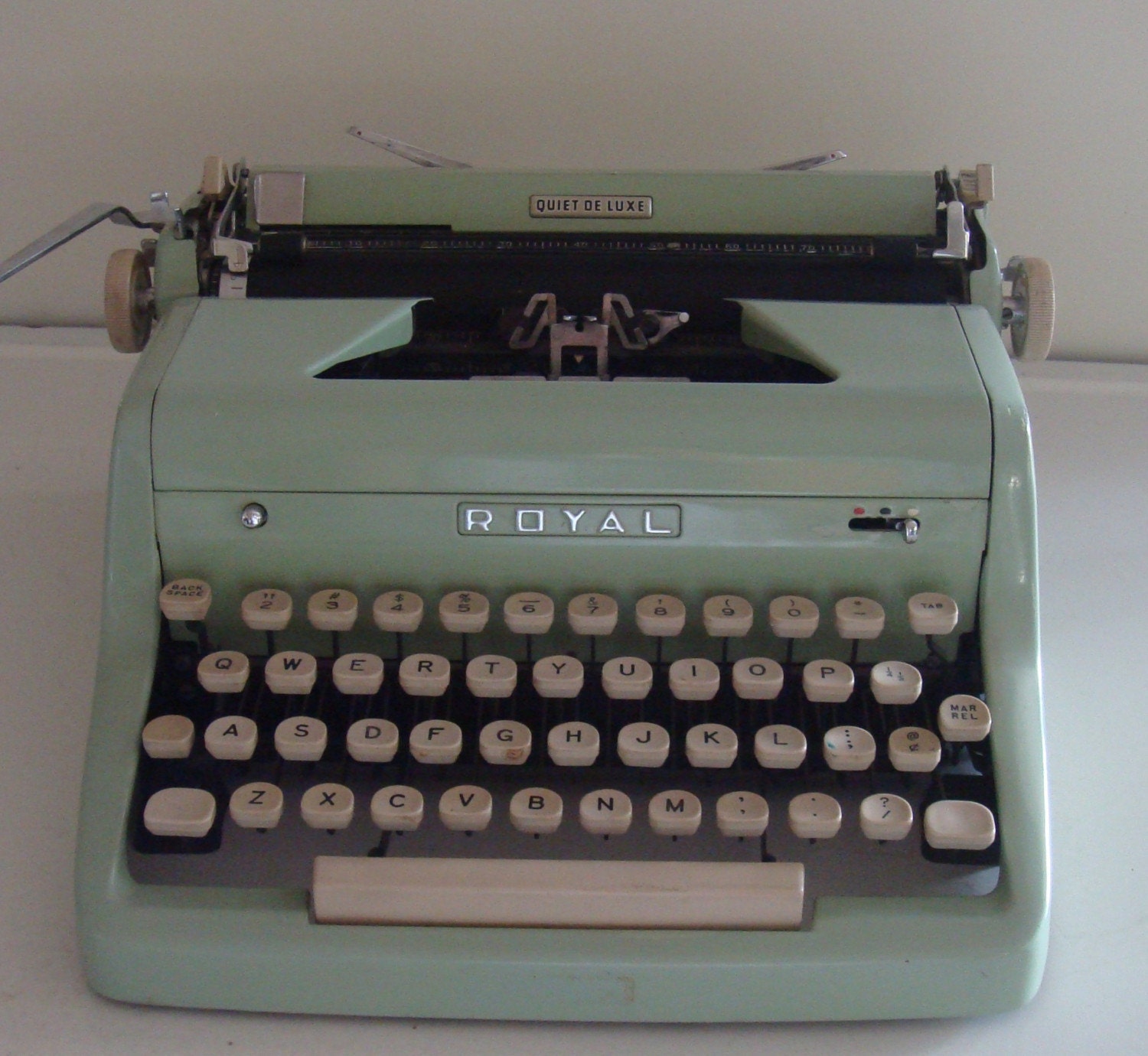
I'm not the biggest fan of mysteries, but I'm already a huge fan of Bloody Typewriter, a new blog which promises to explore the relationship between the genre and all things scribeomechanical. Check out the central graphic, created by blogmisstress Hannah Born from a Flickr photo by typospherian Olivander
The thing is, Bloody Typewriter seems to be mostly conceptual at the moment. It's currently post-free. I'm unsure if that's because postings have been pulled into editorial dry-dock, or they've yet to be unveiled. At any rate, it's a great idea. Any one want to give Bloody Typewriter a nudge? Perhaps ideas would be welcome.

Saturday, June 27, 2009

A Robotron Story, or, What's YOUR Excuse?

I recently came across a reference to a "Robotron" manual typewriter, and at first I thought it was concocted term out of Steampunk fiction. Why else would a writing machine (not even an electric one, mind you) bear such a high-tech moniker? 
File:VEB Robotron.svg
Robotrons are real. The VEB Kombinat Robotron was a manufacturing combine formed in Communist East Germany in 1969, headquartered in Dresden. They made computers--mainframes, minicomputers and, toward the end of their existence (they were liquidated during German Reunification), some personal computers as well. But given that the market for cutting edge technology was somewhat limited behind the Iron Curtain, they diversified into other, more prosaic products: radios, televisions and typewriters.  Here's a sample of their latter wares, rolling off an assembly line in 1987:
File:Bundesarchiv Bild 183-1987-0125-004, VEB Robotron Elektronik Dresden, Endmontage.jpg

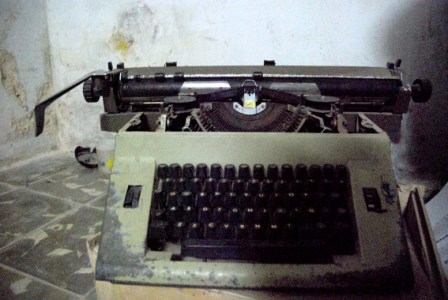
Yeah, not too exciting a piece of engineering. It's described as "a typical Soviet Bloc tool: crude, heavy and indestructible." Seems to owe at least a few stylistic cues to Olivetti, although some models seem more physically reminiscent of Olympias. Take a look at this one and see if it doesn't remind you of an SM-9. 
My East German Robotron wonder.
This beat-up model has a particularly interesting story behind it. It belongs to Yordanka Caridad, a Cuban author and photojournalist. As she explains in a Havana Times reminiscence
"I borrowed it (when I was 20) from a relative who had stolen it from some office, where he said they didn’t use it. I still haven’t returned it to him. At the time it was part of my dream come true...Its keys, a bit obstinate, helped me to become stricken with numerous bouts of tendonitis, but also with more than 10 books. "
Yup, she's written (more than) ten books on this beast. As she points out, she has no alternative: "Until a year ago, it was generally not allowed to bring computers into the country. Now they’re sold in foreign currency stores, but with my impressive salary I can’t even think of buying such a device." 
My hat is already off to Ms. Caridad. But what's fascinating is that she wrote her latest novel on it in fifteen days. Without a typewriter ribbon.
In fifteen days. Without a typewriter ribbon.
Since ribbons--like almost everything--are hard to come by in embargo-era Cuba, she wrote it with a supply of carbon paper.
"It’s relatively easy to write without a ribbon, using a white sheet of paper with carbon paper on top. Though all you can see is the black sheet as you write, at least you have the security that the final copy won’t fade so easily.

From time to time you have to remember what was written at the top of the page; that’s easy, you remove the carbon paper, read it, and then slide the sheets back into place, trying to situate them where you left your last half-completed sentence."
Caridad pronounces this semi-blind typing "a good technique, especially since it permitted me to finish so soon." The novel, Lia el sexo oscuro (Leah: The Dark Sex) found a publisher and will hit the bookshelves in a few months. 
So...let's take stock. This is a published novel, written in half the time allotted for NaNoWriMo, on a battered, marginally-functional typewriter missing a ribbon cover and a ribbon. 
I don't know about you, but I'm speechless. And, I suppose, fresh out of excuses.

(a shoutout to Clickthing for his link to Caridad's essay.)

Thursday, June 4, 2009

The Mystery of the Typewritten Stamps

You know Long Island? Not the one in New York, but the Long Island in the Gulf of Smyrna, off the coast of Greece?
Yeah, me neither. But it turns out that back in 1916, this little corner of the Mediterranean was occupied by the British Navy. For reasons that remain unclear, they promptly issued postage stamps written on typewriters. Here's a sample:

This one went on auction recently at the Colonial Stamp Company in Los Angeles (yes, an auction company specializing not in stamps, but in colonial stamps). It's described as "1d red typewritten on thin horizontally laid paper, initialed in red ink, while 881 were issued only 220 (11 sheets) were typed of the red top sheets, rare and undercatalogued as the issue is so seldom seen, imperf, four margins." The estimated bid price? $750. 
I was about to say something about how people were much more trusting in the past. I mean, a stamp anyone could duplicate on a typewriter? But then I thought about that price...once again, for something that anyone could duplicate on a typewriter. Maybe we're just as trusting now.
These stamps are definitely curiosities of history, but they're also something of a mystery. According to another stamp auction house, they were issued only from May 7 to May 26, 1916, but moreover "the status of these stamps is questionable, as the British force would have had free postage." 
In other words, it's quite possible that someone in the British Navy had a typewriter, some paper, and the desire to look busy. 

Typewriters: a 21st century technology?

Just noticed this one: John-Paul Flintoff writes for the (UK) Sunday Times on environmental topics and "green" technology. In an article entitled "Bring Back Low Tech and  Stop Climate Change" it occurs to him to combine profession and subject...by buying a manual typewriter. He even typecasts on it:
While noting that he's "fully aware of the irony of posting this on the internet, which will only be available to you so long as you, and some remote server, are burning up the fossil fuels," he makes two points about his new acquisition: 
  • a.) it uses no electricity, and 
  • b.)  putting it to use keeps a big ol' hunk of metal, plastic and rubber out of the dump.
"I hope it might inspire you to reclaim some specimen of beautifully made pre-digital low-tech before it's sent to the landfill," Flintoff writes.  

It's environmentally positive in a few other ways too, isn't it? This is off the top of my head:
  • Toner cartridges versus typewriter ribbons. One is an expensive, intricate, proprietary delivery mechanism for powdered chemicals. The other is a strip of cloth dipped in ink.
  • Less paper used. Yes, really. You might think that having to retype would lead to more wasted pages, but in my experience the opposite is true. On the computer, I find myself often printing out drafts, because it's just the touch of a button. On a typewriter, you think twice.
  • Extended lifespan of computers. If you're using your writing machine to write, you're using your computer less. That means reduced wear and tear, and longer product life.
What about you? Can you think of other ways typewriter usage contributes to the environment (and one's pocketbook)?

Wednesday, June 4, 2008

Bad Blurbs, Good Books

The economist Brad DeLong puts forth an interesting "parlor game" on his blog: write the worst blurb you can imagine for the best book you can think of. It's an illuminating exercise, because it helps one realize a couple of things:

1.) that "literary" is really a perceptive filter, a sort of lighting effect that casts a work as somehow Important.

2.) that even works of high literature are propelled by plots. When you strip them down to that level, some etherial classics have rather down-to-earth dynamics at their core.

DeLong's bad blurb for Lord of the Rings is priceless: 
Plucky heros travel across a fantasy world, encountering strange creatures and languages (invented by the author!) to destroy a magic artifact, while being pursued by Minions of the Dark Lord.

(Note: I do have to point out one thing, though: These aren't really "blurbs", per se. A blurb is a dollop of praise, doled out by one author for another. These are imagined instances of jacket copy, which pursues an enticing precĂ­s of the story within the covers. There's a difference, but the exercise remains worthwhile.)

Saturday, May 3, 2008

[sound of platen racheting fresh sheet of paper]


Yes, it's another blog popping its head up into the world. 

I know: thrilling.

But I promise you something. This blog will have a purpose, even a philosophy. It will be a tool for YOU to use. It will not just be unmitigated blather.

(That doesn't eliminate the possibility it will be mitigated blather, of course).

Anyway, hello.

 
blog template by yummylolly.com : header hand photo by Aaron Murphy